
Thalia
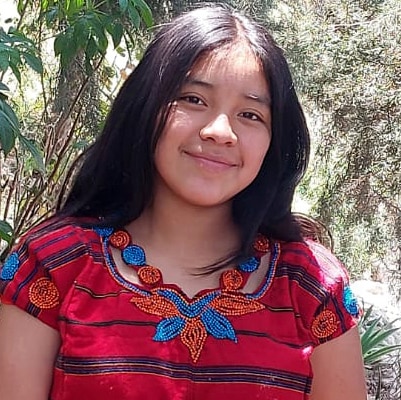
Thalia Anahi Lopez Minera
Date of Birth: August 27, 2004
Year in School: Equivalent of 9th grade
Cost per Year: $2950
Location: Rancho Alegre Cajola, Guatemala

ABOUT
Christa, Janeece, and Leslie first met Thalia in 2019, during a visit to Guatemala with the Flagstaff Arts and Leadership Academy. Thalia is deaf, and one of the FALA students knew some sign language, so they spent a lot of time making art together.
Thalia has been learning sign language and now is learning to read lips. Her school situation is challenging, however, since she has to travel 4 hours round trip each day with her mother to be able to study at the school for deaf students. Here is the letter of recommendation from our contacts at Colectivo Vida Digna.
Dear fellow ONE board of directors,
I hereby greet you, sending you big hugs in gratitude for your dedication to the education of girls around the world. Allow me to introduce myself, my name is Gloribel Salanic, I began my collaboration with the Asociación Colectivo Vida Digna in 2022 in the area of education, providing counseling and educational accompaniment to the girls and boys with scholarships. The surprise of my job was meeting Thalia Lopez Minera, a young 18-year-old Maya Mam, who has been deaf since she was born and lives in the community of Rancho Alegre Cajola, in Quetzaltenango in western Guatemala. It gives me so much satisfaction to recommend her for a ONE scholarship because she is a young woman who works hard to achieve what she sets out to do.
Thalia is currently studying at the Benemerito Committee for the Blind and Deaf of Guatemala, Educational Center for Deaf Children, Western Region “Ora. H.C. Elisa Molina de Stahl”. From the beginning Thalia and the dedication of both parents, Guadalupe and Yaneth, amazed me since they watch over the education of her daughter with great interest and affection. The serious language tool in conjunction with learning to lip read has been helping Thalia to communicate and develop. She highlighted that during her childhood she has gone through very difficult times, however her own initiative has been her tool to overcome these situations. One of the barriers that limited her from continuing to study is the distance between the school and her community, all of which implied that Thalia and her mother had to get up at four in the morning to travel, since the journey takes two hours to travel to get to school.
It has been very difficult for the family because of the economic expense of public transportation and her mother’s time because she stays waiting for her during classes. In addition, the insecurity that exists within the country does not allow her to travel alone to take her classes. This year we managed to find a family in Quetzaltenango, where Thalia has been able to stay since the beginning of classes in January. We hope with a scholarship from ONE she can continue to live close to the school.
Thalia’s letter to us for her application was very heartfelt and tells us a lot about this young woman.
Quetzaltenango, 4 April, 2023
Good day, My name is Thalia Lopez Minera. I am from Cajola and I am 18 years old.
When I was four years old I went to the school in Quetzaltenango for deaf children. I felt out of place and I cried a lot. They spoke to me in sign language and I didn’t understand because I was young, but later I learned a little because I had a very nice teacher.
After a year, my parents took me out of the school because they couldn’t pay and they sent me to the school in my community.
I felt happy in my community but only with my friends because we played and all, but to write I just copied what was on the blackboard because I didn’t understand. My teacher in the community school didn’t know sign language, just like me. I just made them up. Some kids rejected me and others liked me. I was there until fifth grade, until I found the opportunity through Vida Digna to study at Elisa Molina School, where I am now. I started again in third grade but I was really happy.
In Eliza Molina I am now in second basic. I like it a lot and I have four friends. They also give workshops at the school and this year I am learning to embroider with a machine. I like it a lot. I have also always loved cake making. Perhaps next year I will learn more.
Now I am learning dance. We are rehearsing a lot and it’s possible that we will compete in the capital city and perhaps also in Panama.
Since February I have lived in Xela so I can be closer to the school. I feel good at the guest house where I stay. I want to continue studying and I hope you can help me with a scholarship. I am going to try hard in all my classes, and I also have the help of my parents and of Vida Digna.
Thalia
We are delighted to provide more than half of Thalia’s scholarship for her to be able to study and not have to travel so far. Colectivo Vida Digna will pay for a portion of her scholarship, we will pay the rest. Thalia is a very special and dedicated young woman, and we’re very happy to have her as part of our family!
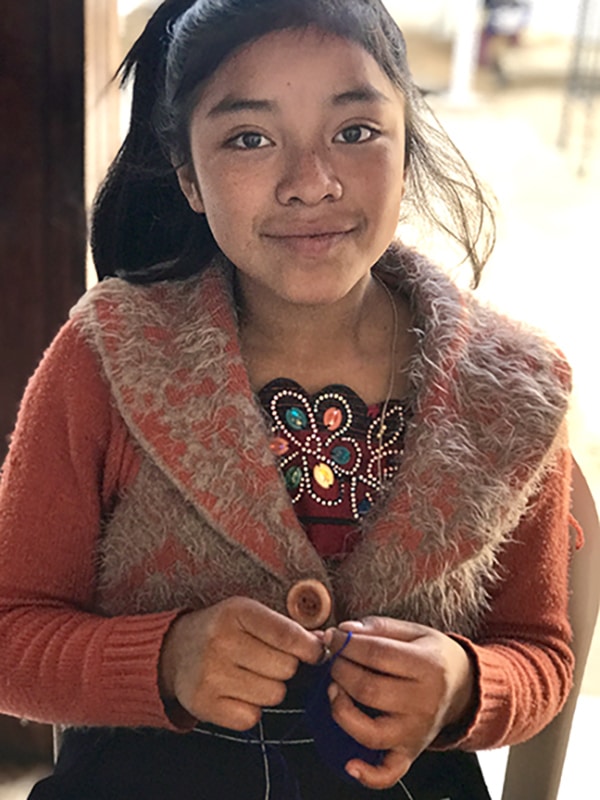
12 year old Thalia
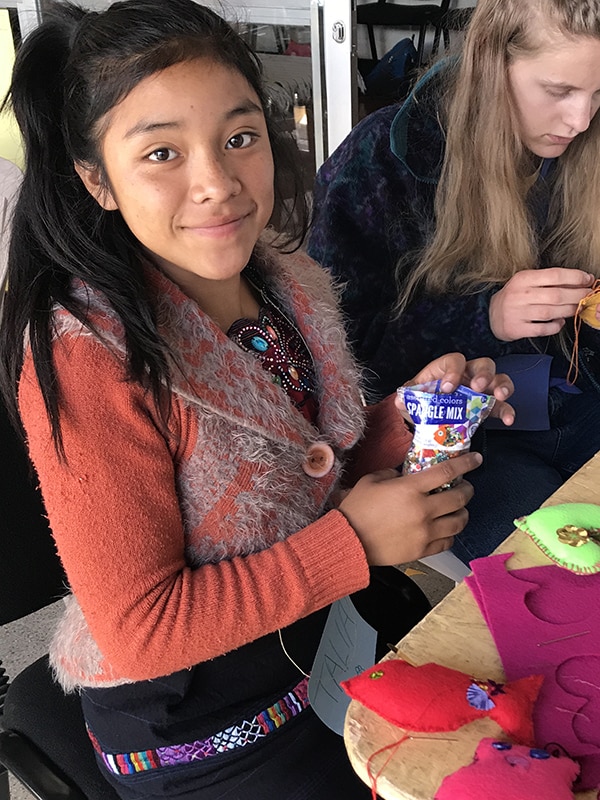
Thalia at 12 years old in 2016
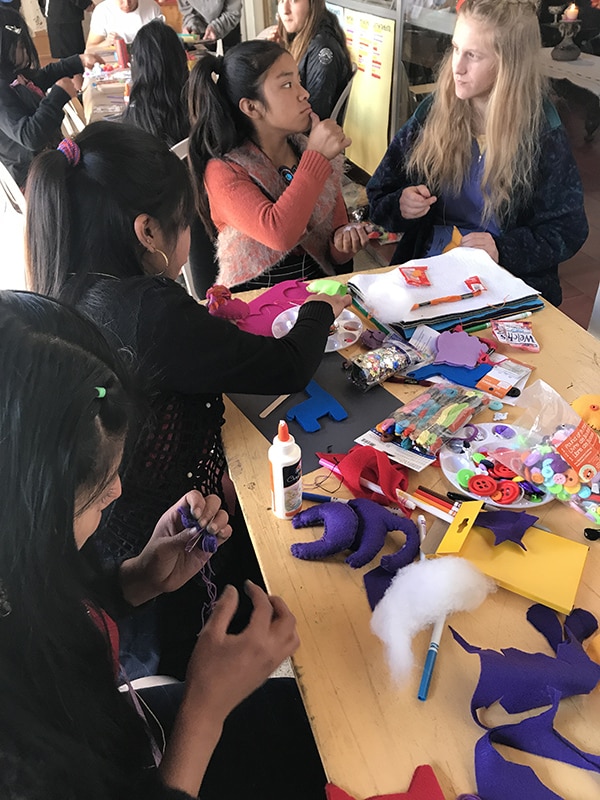
Thalia signing with a FALA student during an art-making class

Thalia at 18
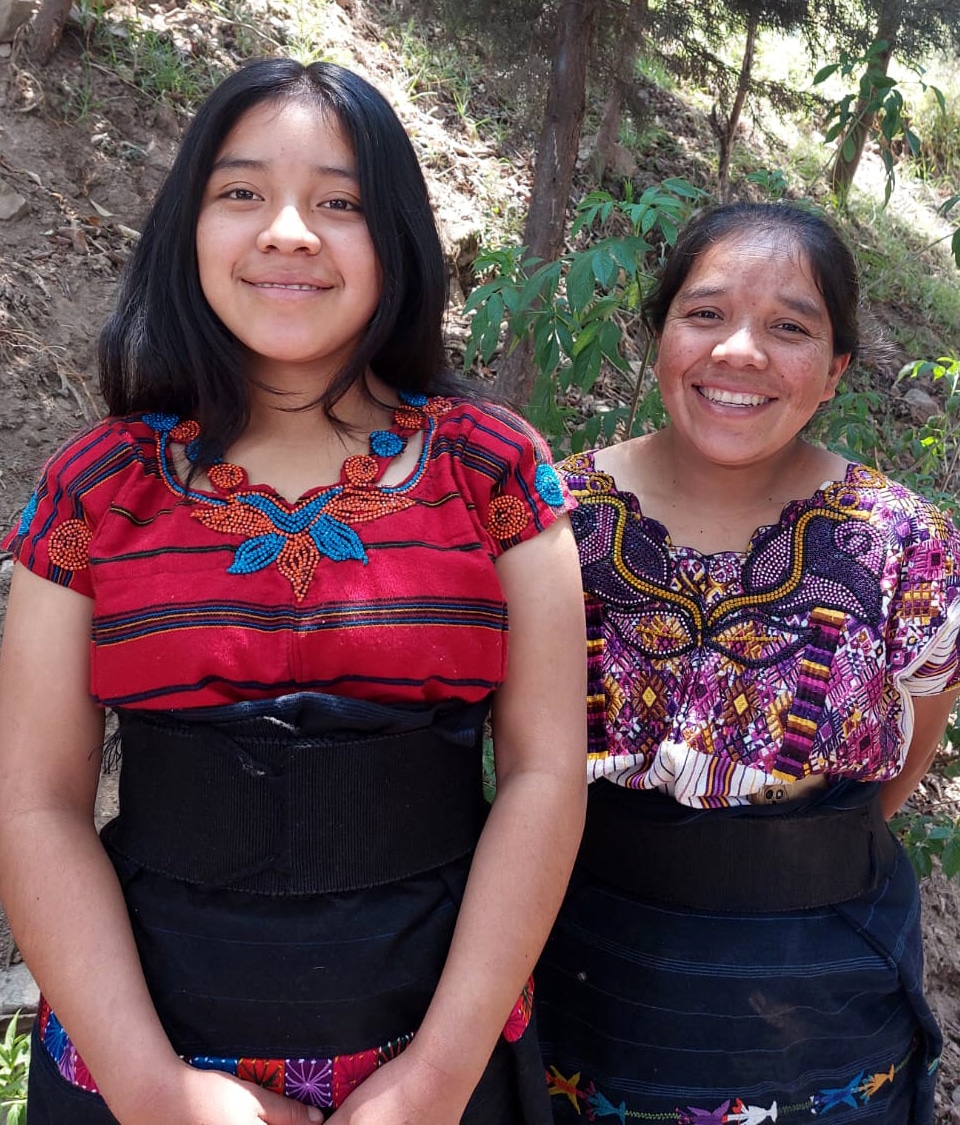
Thalia and her mother

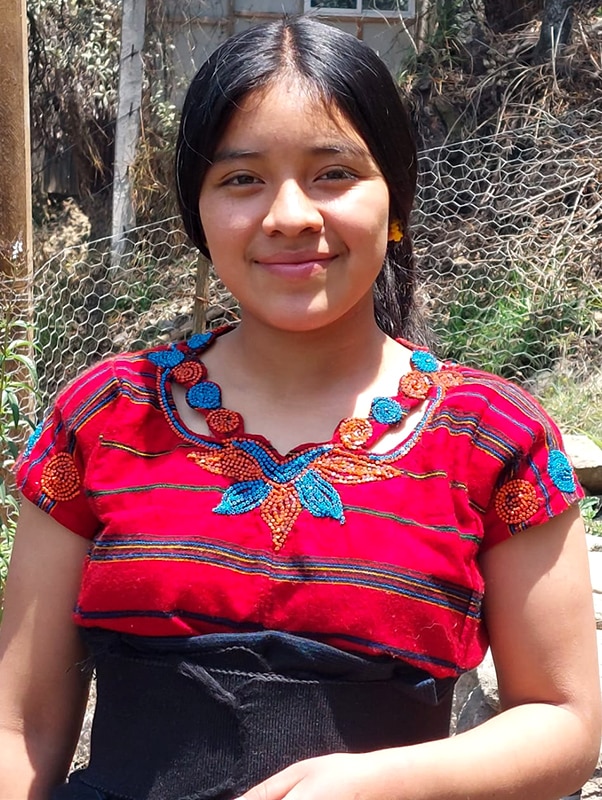
Thalia
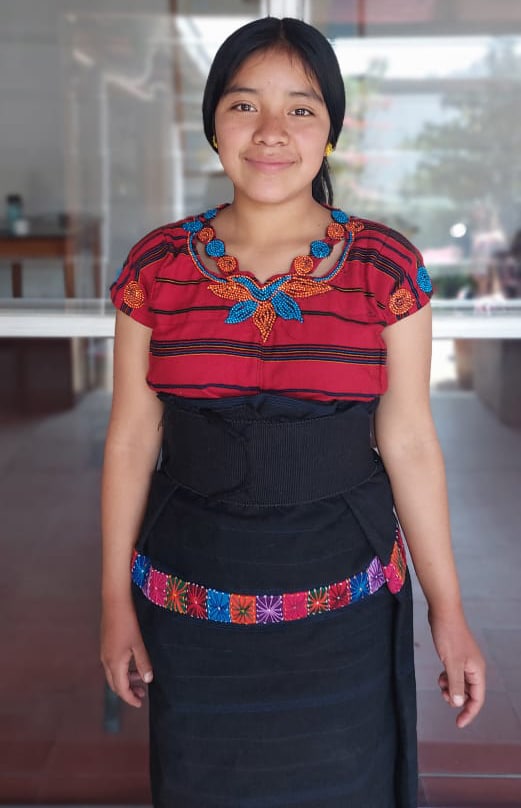
Beautiful young woman!

2023
December 2023
Thalia passed her year and from her letter to us, it sounds like it was a really good one, both emotionally and academically. Her family is learning how to communicate with her and including her in more activities; she’s making new friends, and participating in some really fun activities. We’re excited for her success and can’t wait to see how next year goes. Here is a translation of her letter to us at the end of the year.
Cajola, 24 of November, 2023
This is Thalia, I am sending you big hugs. I am grateful for the help that I received during this year, and I hope to see you one day.
- What was the most difficult thing about this year?
Returning to school in order to take in-person classes, because it is two hours on the road, from very early in the morning from my house without being accompanied by my mother because she’s watching my brothers to make sure they go to school, and also the necessities of the house. Traveling alone makes me embarrassed because I can’t talk. I feel like people there are making fun of me.
- What was the best thing?
I found a place to stay after finishing my classes; I’m less tired; the acceptance of the family towards me; helping with food preparation and cleaning my room; their confidence in chatting with me. I love it because they are learning my language. I feel like I have another family; this is a new memory from this year.
- What do you feel proudest of having done this year?
The opportunity that they gave me to participate in a dance group. During rehearsal days I was concentrating on learning the steps. They gave us the chance to travel to Panama and we came in third place. But I didn’t forget the rest of my classes, and I passed the year, which makes me happy.
- Tell us what makes you happy for the coming school year.
To learn new things from my teachers, classmates and friends. To participate in activities that the school plans. To apply myself to my studies from the first day of class and improve my grades. To finish primary school. I’m excited for my graduation and to work even harder for that day to arrive.
- Who is your best friend?
Yanila is my best friend in school. She has a very calm character. Nothing makes her mad. She asks me to please explain again the topic we cover in class. We share our happiness and play together at recess. My second best friend is Evelyn. We participate together in dance and she helps me with the steps because she is really good at sign language. She is the intermediate who speaks it, who supports a new teacher and the parents in the educational processes of the students.
- What would you like to do in the future with people close to you?
My education is helping me understand the necessities of the people around me. I want to help them in different ways so that they will feel good. I want to be a painter because in that way I can express what I am feeling. Investing my time in doing it, exposing it to other people, and motivating young people that yes, we have talents, it is only about discovering them and feeling proud of our accomplishments and successes.
Thalia Anahi Lopez Minera
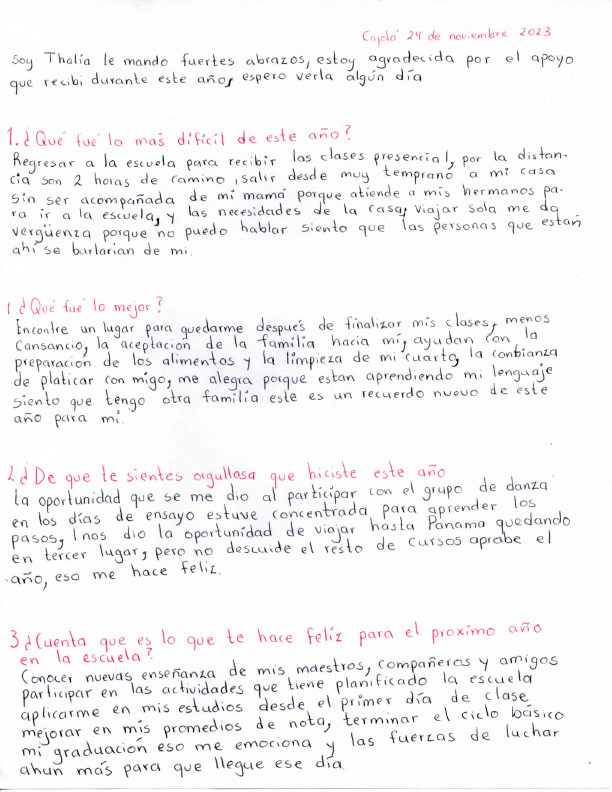
Thalia’s year-end letter to us.
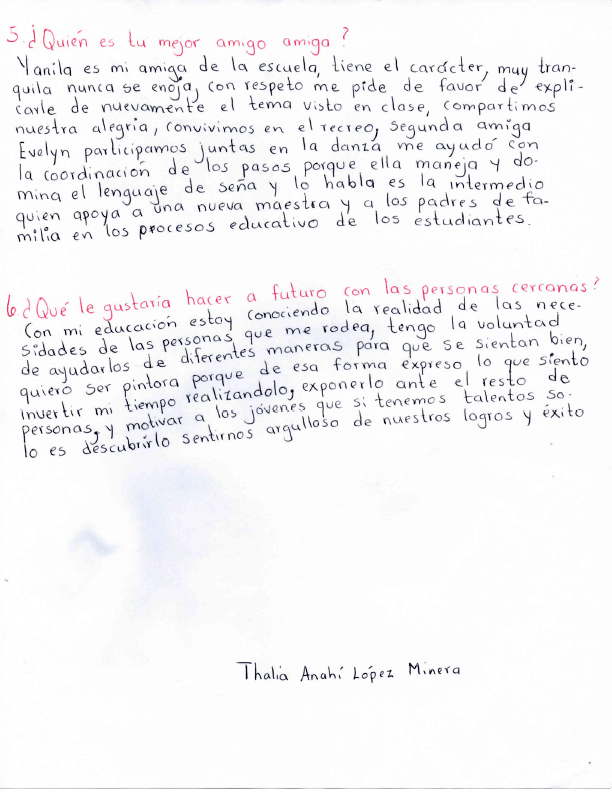
Thalia’s year-end letter to us.
October 2023
Thalia has been doing well in school, her semester report card was an 82%, which is really good. She’s learning to read lips as well as her sign language, and we hear this is doing wonders for her confidence. For the year so far in school she has received either “good” or “excellent” ratings in terms of her accomplishing the tasks set out for her by her teachers (respecting the belongings of her classmates, completing homework, collaborating with her classmates, etc.). We’re really proud of her efforts!
We sent her some questions to answer for her first letter at the semester. She’s never had to do anything like this before so her answers were a bit on the slim side, but we’ll work with our contacts at Vida Digna to make sure she understands that we’d like her to be able to explain things to us just a little bit more!
- What have you learned during the last six months of your school year?
I have learned about physics, and mathematics, and all my materials. I have also learned how to dance and I have learned many things
- What have you learned from the topics taught by your teacher during this time?
I have learned respect and to care for the environment.
- How do you feel about your education after having finished the first half of the school year?
A little tired, frustrated. But I want to continue to reach my goal.
- What are you hoping to learn for the second half of the school year?
I want to learn more therapy. More vocabulary and numbers.
We’re not sure what she means by therapy, so next time we talk to her, we’ll ask what that means!
In September, Thalia was also able to participate in a dance workshop in Panama for dancers from all over Central America who have auditory disabilities. Our contact Anna said she had a really good time and she also sent us a link to the event announcement on Facebook. It’s pretty cute. You don’t have to have a Facebook account or log in to see it.
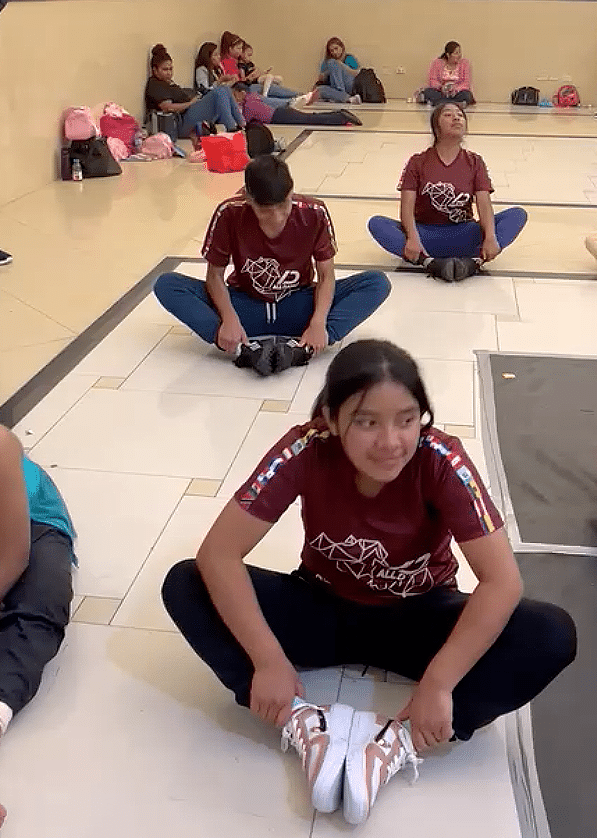
Thalia warming up at a dance workshop in Panama